
Astrology 101: Your Go-To Glossary
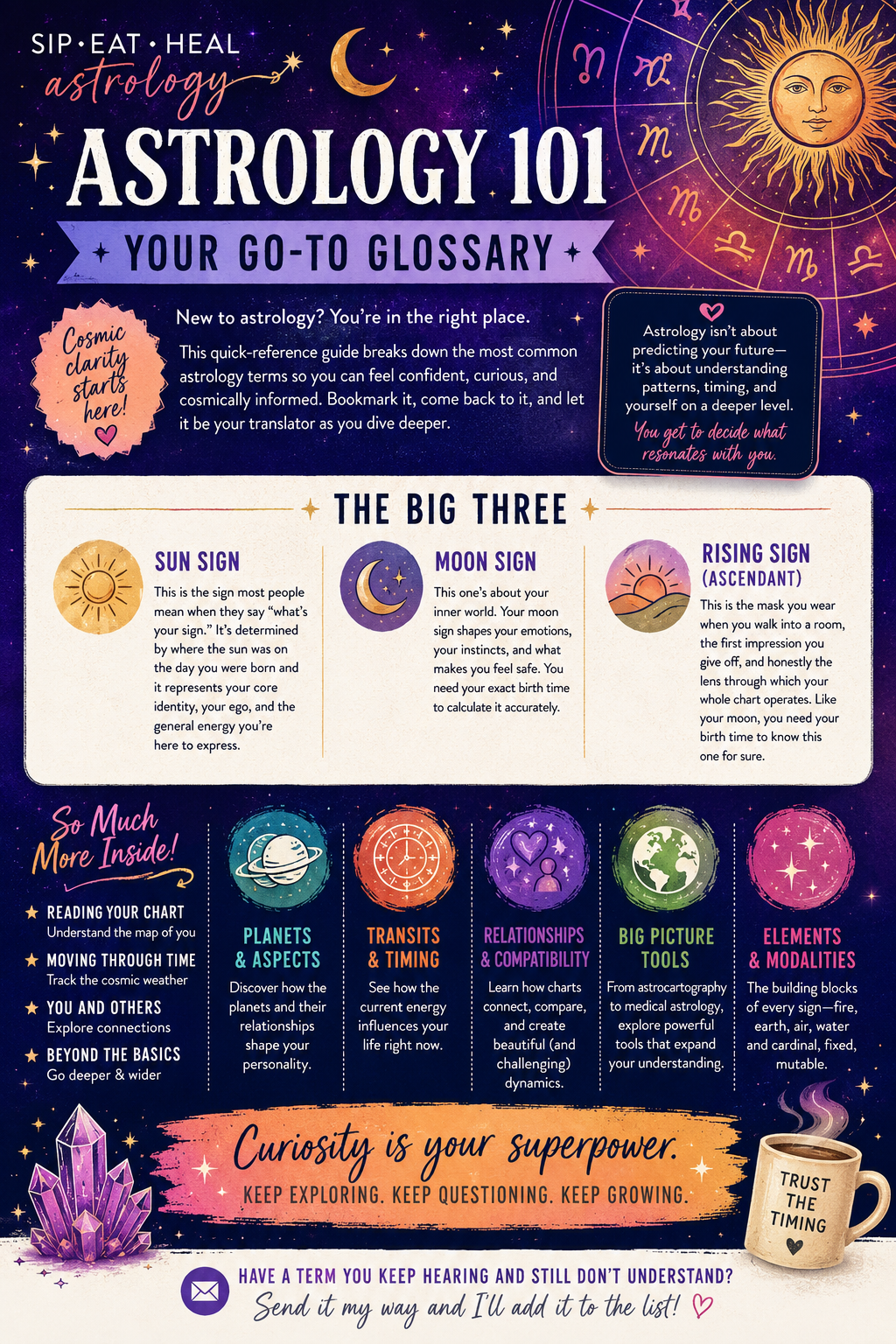
Welcome, cosmic beginner. If you’ve ever nodded along in an astrology conversation while secretly having no idea what a “stellium” is, this page is for you. Bookmark it, come back to it, and let it be your translator as you dive deeper into the Sip · Eat · Heal astrology world.
What Is Astrology, Really?
At its core, astrology is the study of the sky and how the positions and movements of the planets can offer insight into who we are and what season of life we’re in. It’s less about predicting your future and more about understanding patterns, timing, and yourself on a deeper level.
If you come from a faith background, you don’t have to choose between your beliefs and exploring astrology. Many people find that astrology works alongside their faith rather than against it, as simply another tool for reflection and self awareness, the same way you might use journaling, therapy, or prayer. Think of it as a language for noticing patterns and timing, not a replacement for your spiritual foundation. You get to decide how much or how little of it you bring into your life, and there’s no pressure to believe anything you’re not ready to believe. Come as you are and take what’s useful to you.
The Big Three
Sun Sign — This is the sign most people mean when they say “what’s your sign.” It’s determined by where the sun was on the day you were born and it represents your core identity, your ego, and the general energy you’re here to express.
Moon Sign — This one’s about your inner world. Your moon sign shapes your emotions, your instincts, and what makes you feel safe. You need your exact birth time to calculate it accurately.
Rising Sign (Ascendant) — This is the mask you wear when you walk into a room, the first impression you give off, and honestly the lens through which your whole chart operates. Like your moon, you need your birth time to know this one for sure.
Reading Your Chart
Natal Chart — Think of this as your cosmic blueprint. It’s a snapshot of exactly where every planet was in the sky at the moment you were born, mapped onto a wheel. Your natal chart is the foundation for everything else in astrology.
Chart Casting — This is simply the process of generating your natal chart. You plug in your birth date, birth time, and birth location, and the chart gets calculated and drawn up for you. You’ll often hear astrologers say “cast a chart” or “pull up your chart,” and both just mean the same thing, generating that wheel of planets based on your birth information so it can be read and interpreted.
House — Your chart is divided into twelve sections called houses, and each one represents a different area of life, like relationships, career, home, or spirituality. Where a planet falls in your chart tells you which area of life that planet’s energy shows up in most.
Planet — In astrology, “planet” is a loose term that includes the actual planets plus the sun and moon. Each one rules a different part of your personality and experience, like Venus for love and beauty or Mars for drive and action.
Aspect — This describes the angle or relationship between two planets in your chart. Aspects tell you how different parts of your personality talk to each other, whether they flow easily or create some friction.
Conjunction, Opposition, Square, Trine, Sextile — These are the five major aspects. A conjunction means two planets are sitting right next to each other, blending their energy. An opposition means they’re across from each other, creating tension or balance. A square means friction and growth. A trine means ease and natural flow. A sextile means opportunity, if you’re willing to put in a little effort.
Stellium — This is when you have three or more planets clustered together in the same sign or house. It creates a concentrated, powerful energy in that one area of life.
Ruling Planet — Every sign has a planet that governs it. For example, Mars rules Aries and Venus rules Taurus. Your ruling planet often has extra influence over your chart.
Moving Through Time
Transit — This is what’s happening in the sky right now, today, compared to your natal chart. When astrologers talk about “the energy of the week,” they’re talking about transits.
Retrograde — This is when a planet appears to move backward in the sky from our view here on Earth. It’s an optical illusion, not an actual reversal, but astrologically it’s a time to slow down, revisit, and review whatever that planet represents.
Void of Course Moon — This happens when the moon has made its last major aspect in a sign and hasn’t entered the next sign yet. It’s considered a pause in the cosmic action, not a great time to start new projects.
Solar Return — This is your astrological birthday chart. It’s cast for the exact moment the sun returns to the same place it was when you were born, and it gives insight into the themes for your upcoming year.
Ephemeris — This is basically an astrologer’s almanac. It’s a table that shows the exact position of every planet on every day, which is what chart casting software uses to build your chart.
Orb — This is the amount of wiggle room allowed for an aspect to still count. Planets don’t have to be in an exact angle to be considered connected, they just have to be within a certain number of degrees, which is the orb.
You and Others
Synastry — This is the comparison of two people’s natal charts to understand compatibility and dynamics in a relationship, romantic or otherwise.
Composite Chart — Instead of comparing two charts side by side, this blends them into one single chart that represents the relationship itself, almost like the relationship is its own entity.
Beyond the Basics
Astrocartography — This maps your natal chart onto the actual globe, showing you where in the world different planetary energies are strongest for you. It’s often used to figure out where you might thrive, travel, or relocate.
Medical Astrology — This is the practice of looking at the body and health through the lens of your chart, connecting different signs and planets to different parts of the body and wellness patterns.
Elements — Every sign belongs to one of four elements: fire, earth, air, or water. Fire signs are passionate and driven, earth signs are grounded and practical, air signs are thinkers and communicators, and water signs are emotional and intuitive.
Modalities — Every sign also falls into one of three modalities: cardinal, fixed, or mutable. Cardinal signs initiate, fixed signs sustain, and mutable signs adapt.
Have a term you keep hearing and still don’t understand? Send it my way and I’ll add it to the list.